Dressing for yourself, at last.
On the year in a woman's life when the mirror stops asking anyone else's opinion. A short piece on style as autobiography — and why almost every woman I love got there in her mid-thirties, roughly a decade later than she should have.
For most of my twenties I dressed for an audience I could not have named if you had asked me. Not for a boyfriend, exactly. Not for my mother, though she was, in the background, always the primary editor. Not for my friends, though I would have said so if pushed. For a diffuse crowd of people whose approval I imagined I needed and whose specific tastes, if you had actually pinned them down, I would not have been able to describe.
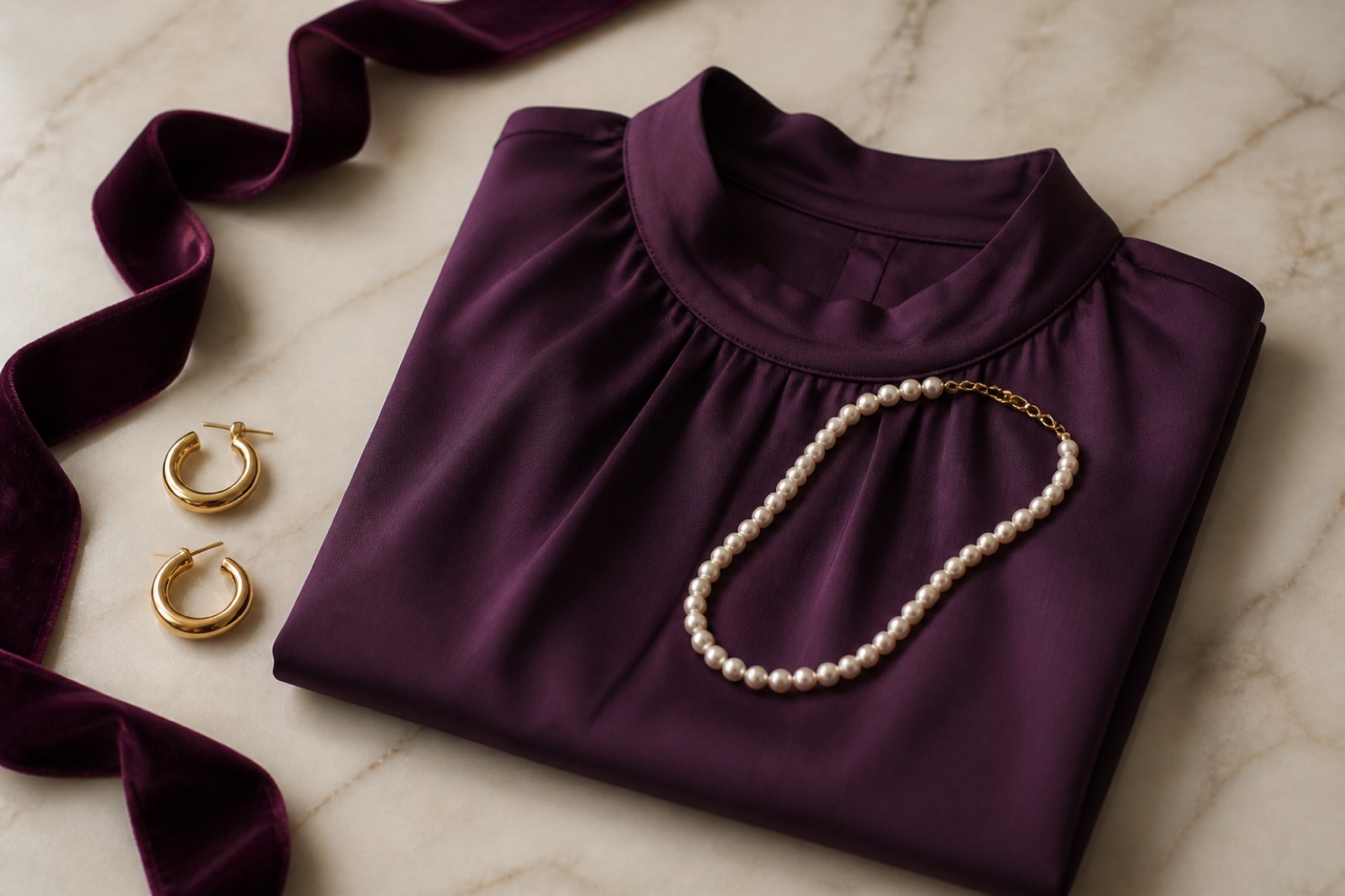
The turning point was not dramatic. It was not, as the magazine version of this piece would have it, "the day I threw out everything that did not spark joy." It was, in fact, roughly the opposite: it was the day I stopped throwing things out. I noticed that a plum silk blouse I had bought on a strange impulse three years earlier was the thing I actually reached for, on the mornings I actually felt like myself. And I noticed that the very expensive black blazer I had bought because it was "a good investment piece" had been worn twice.
The mirror question
There is a question a woman gets in the habit of asking herself, at the mirror, sometime in her early twenties. She is often not aware she is asking it. The question is: what will they think of this? The they is unspecified. Sometimes it is her mother. Sometimes it is a man. Sometimes it is a room of women she does not particularly like but whose approval she has, for reasons no longer clear to her, allowed to matter.
The mirror question runs, in most of us, for about a decade before we notice it is running. When we finally notice, the strangeness of the arrangement is startling. You have been standing at a mirror, several times a day, for ten years, quietly consulting a committee of imaginary strangers about a shirt.
Style is not the arrangement of the clothes. It is the arrangement of the woman inside them.
What replaces the question
It is not another question. It is, if it is anything, a small internal silence in front of the mirror, followed by a very short private sentence. The sentence, in the women I have watched go through this, is nearly always some version of: yes, that is who I am today. Or: no, that is who I was two years ago. It is a sentence with an "I" in it. There is no "they" in it any more.
This does not mean the woman has become indifferent to how she looks. Almost none of the women I love have become indifferent to how they look. They have, instead, moved the source of the judgment from outside the body to inside it. What they wear now serves a story only they know, and if the story requires a plum silk blouse and gold hoops on a Tuesday in November, then that is what the Tuesday requires, and no one at the office is entitled to a vote.
Small evidence
The signs of a woman who has arrived here are not obvious. Her wardrobe is often smaller than it used to be, not bigger. She has fewer pieces, and she wears them more. She has, quietly, developed a uniform, though she would probably not use that word. She has stopped experimenting for the sake of experimenting; she experiments now only in the direction of things that have already worked.
She also, and this took me a long time to notice, buys things she cannot fully justify. This is one of the more reliable signals. She has moved past the phase in which every purchase must be defensible on grounds of cost-per-wear or investment or utility. She will buy a scarf that is expensive and impractical because she liked it in the shop. She is not indulging. She is exercising the muscle. The reason she looks the way she does at forty-two is that she has spent a decade making small, unjustifiable choices about her own aesthetic, and the choices have added up to a woman with a signature.
Style as autobiography
The women whose style I admire most, at forty and at sixty, do not look "well-dressed" in any generic sense. They look like themselves. The way they dress is, in the most literal sense, autobiographical. You can, if you know how to read it, see the whole of a life in it: the country the woman is from, the twenty-year love affair, the year she stopped caring what the boardroom thought, the small stubborn devotion to a specific shade of green.
This is not something you can shop your way into. You cannot copy it. You cannot, in particular, order the online version of it. Every woman's version of her own style is a slow accretion of many small choices, and the choices are not, in the end, about clothes. They are about a growing willingness to appear in the world as the person you actually are.
How to start
You do not need to buy anything. In fact, if you have just read this and immediately wanted to buy something, that is, I would gently suggest, the exact instinct we are trying to un-learn.
Instead: for the next month, at the mirror, notice the question. If you catch yourself asking, silently, what will they think of this? — pause for a beat. Try, in that beat, a different question. Do I feel like myself in this? That is the whole practice. It sounds absurdly small. It is not small. It is one of the more consequential small daily practices a woman can develop, and if you keep at it for a year you will emerge into a wardrobe you did not consciously assemble, but which fits you in a way nothing you owned five years ago ever quite did.
The mirror, at that point, has stopped asking anyone else's opinion. That is the whole of the essay. Everything else — the plum silk, the pearls, the gold hoops that have been in the drawer for eight years and finally have somewhere to go — is only the pleasant, slightly late consequence.
Lila Kaur is a writer and former buyer in Milan. She still owns the plum silk blouse.